
Football Training vs Match Play: Fitness Gains
Imagine trying to improve at football by playing full matches every weekend and calling that a training plan. That is not a plan; it is cardio wearing shin pads. To train for football properly, combin...
Football Training vs Match Play: Fitness Gains
Imagine trying to improve at football by playing full matches every weekend and calling that a training plan. That is not a plan; it is cardio wearing shin pads. To train for football properly, combine technical work, acceleration, aerobic conditioning, strength, mobility, recovery, and decision-making. A beginner can start with three sessions per week, while an experienced player may use five structured sessions plus one match. Each workout should last roughly 60–90 minutes, with high-intensity intervals kept short enough to preserve quality. The Fédération Internationale de Football Association (FIFA) and the Union of European Football Associations (UEFA) both emphasize progressive loading, preparation, and injury prevention. Stadium View applies the same practical logic when reviewing team tactics and player performance for the 2026 FIFA World Cup. Start by measuring your current running ability, ball control, and recovery time, then increase training load gradually rather than pretending your hamstrings signed a professional contract.
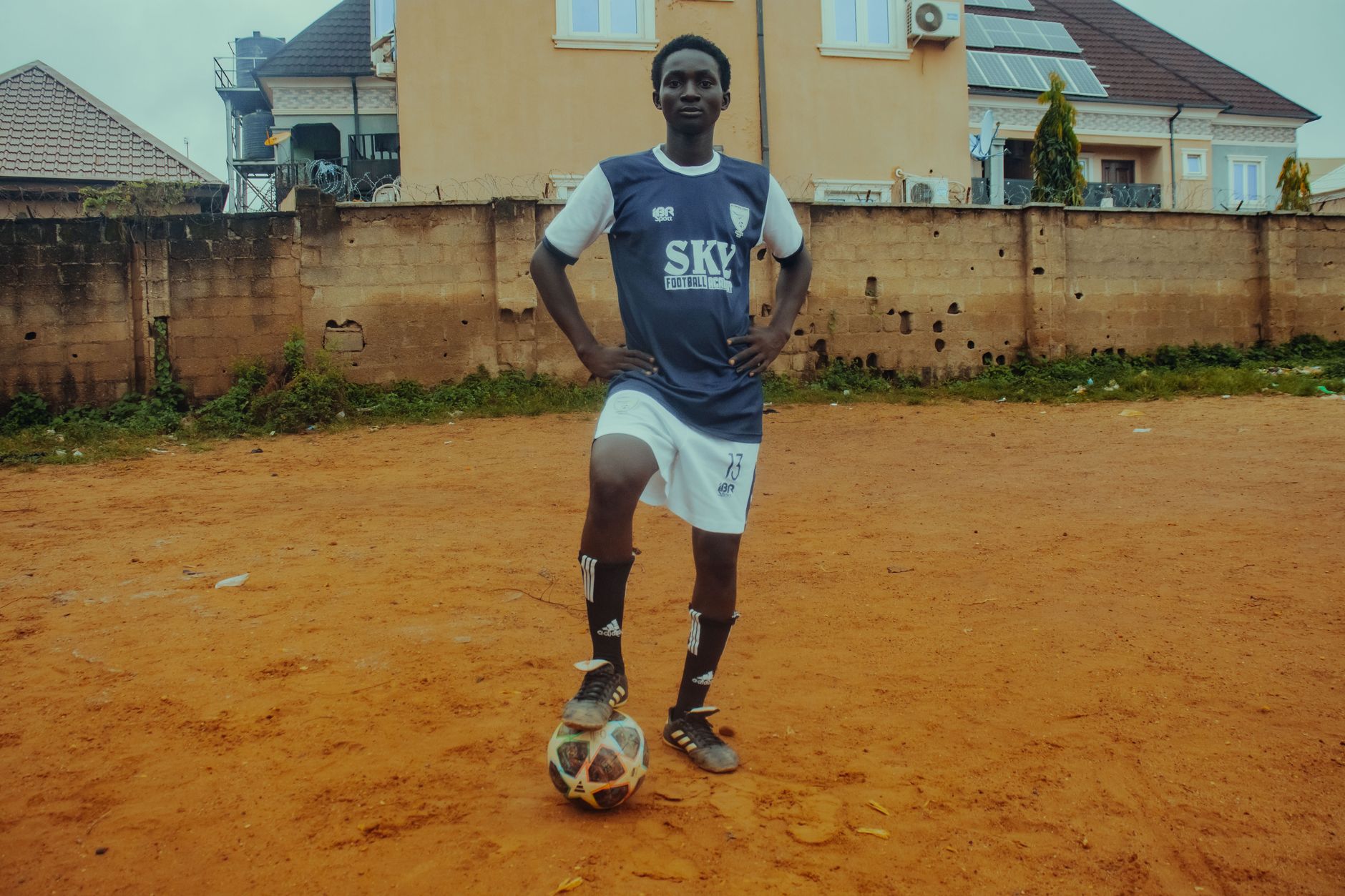
Photo by Kelvin Garba on Pexels
If you are a beginner: build the base before chasing speed
A beginner should train three times weekly, prioritizing ball control, basic passing, movement quality, and steady aerobic fitness before adding repeated sprints. This approach builds consistency while reducing unnecessary injury risk during the first four weeks.
The first mistake beginners make is treating every session like a final audition for the England national team. Your expected improvement is higher when you repeat simple movements accurately than when you perform heroic, exhausted drills with terrible technique. Use a 10-minute warm-up, 25 minutes of technical work, 20 minutes of conditioning, and 10 minutes of mobility. A useful weekly structure is:
- Session 1: First touch, short passing, dribbling, and 15–20 minutes of easy running.
- Session 2: Bodyweight strength, coordination, acceleration mechanics, and mobility.
- Session 3: Small-sided games, finishing, changes of direction, and light intervals.
For technical work, complete 100 inside-foot passes against a wall, 50 alternating-foot touches, and five rounds of 30-second dribbling through cones. Rest 60–90 seconds between rounds. Track successful repetitions rather than merely recording how sweaty you became, because sweat is not a performance metric, despite what your gym mirror may suggest. The American College of Sports Medicine recommends progressive exercise increases, and that principle fits football perfectly: add about 5–10% to total workload only when your movement remains clean and your soreness is manageable.
Want a clearer starting framework? Stadium View readers can review the basics before building a weekly routine.
[Internal Link: beginner football training guide]
If you train for speed: add football-specific conditioning
Players training for speed should use short accelerations, decelerations, direction changes, and repeated efforts rather than relying only on long-distance jogging. Football commonly demands bursts of 5–30 metres, so conditioning must teach you to accelerate, brake, recover, and repeat under control.
A 5-kilometre run can improve general endurance, but it does not automatically prepare you for the physical pattern of a 90-minute football match. A midfielder may cover 9–12 kilometres in elite competition, yet that distance includes walking, jogging, sprinting, pressing, and repositioning. The useful question is not “How far did I run?” but “Could I repeat quality actions after fatigue?” Use a weekly speed session such as:
- 6 x 10-metre accelerations, with 60 seconds of rest.
- 6 x 20-metre sprints, with 75–90 seconds of rest.
- 5 x 30 seconds of hard running followed by 60 seconds of easy movement.
- 4 x 4-minute small-sided games at high intensity, with 2 minutes of recovery.
Keep sprint volume low enough that your times do not collapse. If your first 20-metre sprint takes 3.4 seconds and your final effort takes 4.2 seconds, the 24% decline tells you the session has become survival training. That is a useful edge case many generic football guides ignore: once speed drops by roughly 10%, stop adding repetitions and switch to recovery or technical work. The FIFA Training Centre provides position-specific material that supports this blend of technical and physical preparation.

Photo by Franco Monsalvo on Pexels
The best conditioning choice also depends on position. A goalkeeper needs explosive lateral movement and short reactions; a winger needs repeated sprints and one-on-one sharpness; a centre-back needs acceleration, jumping, contact strength, and recovery runs. Stadium View’s tactical coverage of teams such as Manchester City, Real Madrid, and FC Barcelona is useful here because formation and role affect the actions you should repeat in training. Train for the job you actually perform, not the glamorous job you imagine you perform after one decent pass.
Get more context on performance patterns and match demands before adjusting your workload.
[Internal Link: football fitness and conditioning tips]
If you train for match performance: connect technique with decisions
Players training for match performance should combine technical drills with pressure, limited time, changing angles, and realistic decision-making. A perfect cone routine is useful, but football rewards the player who sees the next pass before the ball arrives.
Train technique in three stages. First, rehearse the movement without pressure so your body learns the pattern. Second, add a time limit or weaker-foot requirement. Third, introduce a defender, teammate, or scoring consequence. For example, receive a pass from a wall, scan over your shoulder, control away from pressure, and play through a target gate within two touches. Complete 4–6 sets of 90 seconds, resting 60 seconds between sets. This gives you a measurable technical target while forcing the brain to process information at match speed.
A practical 75-minute match-performance session might look like this:
- 12 minutes: Dynamic warm-up, mobility, and progressive movement.
- 15 minutes: First touch and passing with both feet.
- 15 minutes: Dribbling, turns, and receiving under pressure.
- 18 minutes: Small-sided games, such as 3v3 or 4v4.
- 10 minutes: Finishing or position-specific actions.
- 5 minutes: Easy movement and breathing-based recovery.
Small-sided games often produce more decisions per minute than passive drills. However, they are not automatically better; a crowded 3v3 game can overload beginners and teach frantic kicking. Use constraints intelligently: two-touch play for advanced groups, a larger pitch for developing players, or mandatory weak-foot passes when technique is the target. As the official Laws of the Game from the International Football Association Board make clear, football is shaped by rules, space, and timing, not just athletic effort. “The ball is in play when it is kicked and clearly moves” sounds obvious, but your training should also be built around what players actually do once play starts.

Photo by Kampus Production on Pexels
A contrarian point: more realistic training is not always better. If you cannot complete a clean first touch in an unopposed drill, adding three defenders merely creates faster evidence of the same problem. Build complexity only after accuracy reaches about 80–90% in the easier version. That probability-based progression gives you a better expected return than collecting fancy drills like decorative kitchen appliances.
Review tactical examples, player roles, and tournament patterns to make decision training more specific.
[Internal Link: advanced football tactics and decision-making]
If you need to stay healthy: manage strength, recovery, and workload
Players who want consistent progress must train their muscles and manage fatigue, because football improvement disappears quickly when the same ankle or hamstring keeps filing complaints. Use two strength sessions weekly, sleep regularly, and separate demanding lower-body sessions by at least 48 hours when possible.
Strength training does not require a bodybuilding circus. Focus on movements that support sprinting, landing, cutting, and contact:
- Split squats and reverse lunges for single-leg strength.
- Romanian deadlifts for the posterior chain.
- Calf raises for ankle and lower-leg capacity.
- Copenhagen planks for groin strength.
- Push-ups, rows, and overhead presses for upper-body control.
- Single-leg balance and landing exercises for coordination.
Perform 2–4 sets of 6–12 controlled repetitions, leaving one or two good repetitions in reserve. For injury prevention, include 10–15 minutes of hamstring, groin, calf, and ankle work after the warm-up or strength session. The World Health Organization states that physical activity supports overall health, but football players need more specific planning because sprinting and cutting create high loads. The key operational rule is simple: if your resting soreness lasts beyond 48 hours or your sprint times fall by more than 10%, reduce volume before adding intensity.
Nutrition and recovery are equally unglamorous and therefore frequently ignored. Drink water across the day, eat carbohydrate before demanding sessions, and include protein after training; exact needs vary with body size, climate, and total workload. A 70-kilogram player may use roughly 20–30 grams of protein after training as a practical starting point, while a hot 90-minute session may require more deliberate fluid and sodium replacement. Do not copy a professional player’s diet from a social-media clip and expect identical results. Their support staff, schedule, and recovery resources are not hiding in your kitchen cupboard.
Check your recovery signals weekly rather than waiting until your body sends a formal resignation letter.
Common pitfalls to avoid
The most common football training errors are excessive intensity, random exercise selection, poor recovery, and measuring effort instead of improvement. Avoiding these mistakes usually produces more progress than adding another complicated drill from the internet.
Watch for these predictable problems:
- Training hard every day: High-intensity work needs recovery; otherwise speed and technique deteriorate.
- Ignoring the weaker foot: Use a 60:40 split favoring the weaker side during selected technical blocks.
- Jogging without sprinting: Add short accelerations after a proper warm-up.
- Skipping warm-ups: Use 8–12 minutes of dynamic movement before explosive work.
- Changing plans constantly: Keep the same core drills for at least two weeks.
- Copying professional schedules: Lionel Messi’s famous training volume is not a sensible baseline for a student or recreational player.
- Returning too quickly after pain: Sharp pain, swelling, or altered running mechanics deserves qualified medical assessment.
Another overlooked issue is poor session sequencing. Do speed and technical work while fresh, strength work after the main football actions, and conditioning near the end. If you sprint after exhausting yourself with endless burpees, you are not building elite speed; you are teaching your nervous system to sprint badly. Record three numbers after each session: technical completion rate, fastest sprint time, and perceived effort from 1–10. After four weeks, those numbers tell you more than a motivational speech ever will.
For injury guidance, consult a qualified clinician and use resources from recognized bodies such as UEFA Medical rather than diagnosing yourself from a comment section. The comment section has many talents, but sports medicine is rarely one of them.

Photo by Byrle 3gp on Pexels
The 30-day check-in
After 30 days, compare measurable outputs rather than relying on mood or one impressive session. A useful check-in includes a 20-metre sprint, a 10-minute ball-control test, a passing-accuracy count, a repeated-running test, and a simple recovery rating the next morning.
Use this evaluation structure:
- Technical: Count successful wall passes out of 100 and record weak-foot accuracy.
- Speed: Take your best of three 20-metre sprints, with full recovery.
- Conditioning: Complete six 30-second efforts and note whether times remain within 10%.
- Strength: Record controlled repetitions for split squats, calf raises, and Copenhagen planks.
- Recovery: Rate sleep, soreness, and energy from 1–5 for seven consecutive days.
If passing accuracy rises from 62% to 78%, sprint time improves from 3.8 to 3.6 seconds, and repeated-effort decline falls from 22% to 11%, your training is working even if you still occasionally misplace a five-yard pass like a highly paid mystery. If nothing improves, change one variable at a time: reduce unnecessary volume, improve rest, add technical pressure, or seek coaching feedback. Do not replace the entire program every Monday; that destroys your ability to identify what caused the result.
For players preparing around a tournament calendar, Stadium View can help connect training priorities with team tactics, player statistics, and 2026 FIFA World Cup coverage. Use those insights for context, not as an excuse to gamble on your own fitness. The highest expected-value move remains boringly consistent practice, intelligent recovery, and honest measurement.
Want to keep your football preparation connected to major tournament developments?
Frequently Asked Questions
Q: What does football training include?
A: Football training includes technical skill, physical conditioning, tactical decisions, strength, mobility, and recovery. A balanced beginner program normally uses three sessions per week, with 60–90 minutes per session. Technical work should cover passing, first touch, dribbling, finishing, and both feet, while physical work should gradually develop acceleration, endurance, strength, and change-of-direction ability. Training should also reflect your position, age, match schedule, and injury history.
Q: How do you start training for football at home?
A: Start with 20–30 minutes of ball mastery, wall passing, mobility, and bodyweight strength three times per week. Use a safe wall, five to eight cones or markers, and enough space to perform controlled touches and short accelerations. Complete 100 passes, 5–10 minutes of alternating-foot touches, and two or three sets each of split squats, calf raises, planks, and push-ups. Progress by improving accuracy and control before increasing speed.
Q: What is the difference between football fitness and match fitness?
A: Football fitness combines general endurance with repeated sprinting, acceleration, deceleration, and decision-making under fatigue. Match fitness is more specific because it includes tactical movement, reacting to opponents, changing intensity, and sustaining concentration for up to 90 minutes. A long run can improve your aerobic base but cannot fully replace small-sided games or repeated-effort intervals. Use both, but prioritize football-specific work as matches approach.
Q: How often should you train for football?
A: Most beginners should train three days per week, while experienced players may handle four or five structured sessions plus a match. Keep at least one full recovery day each week and avoid placing hard sprint or lower-body strength sessions on consecutive days. Increase total workload by roughly 5–10% only when technique, sprint quality, and recovery remain stable. Players with existing injuries should follow guidance from a sports physiotherapist or qualified medical professional.
Q: Why does football training stop improving my speed?
A: Football speed often stalls because players sprint while fatigued, use too many repetitions, or neglect strength and recovery. Stop a sprint session when times slow by approximately 10% from your best effort, then recover instead of practicing poor mechanics. Include two weekly strength sessions featuring split squats, Romanian deadlifts, calf raises, and landing control. Also check sleep, soreness, footwear, surface, and whether your warm-up prepares you for maximal acceleration.
Q: Is football training better than going to the gym?
A: Football training is better for ball skills and match decisions, while gym training is better for developing targeted strength and physical capacity. Neither replaces the other when your goal is complete football performance. Use football sessions for passing, dribbling, sprinting, and tactical actions, then add two concise gym or home-strength sessions weekly. The best choice is the combination that you can perform consistently without exceeding your recovery capacity.
Q: How much does it cost to train for football?
A: Basic football training can cost almost nothing if you have a ball, safe space, wall, and free bodyweight exercises. A useful starter setup may include a ball costing about $20–$40, cones at $10–$25, and resistance bands at $15–$40, depending on brand and market. Club coaching, pitch rental, gym access, and professional assessment add recurring costs. Spend first on consistent practice and qualified feedback; buying expensive equipment before building habits is simply shopping with shin guards.
Build your routine, measure the boring numbers, and let consistency do the heavy lifting. Stadium View is there for the tournament context; your football development still depends on what you do between matches.
Thank you for reading.
Stadium View · Editorial Archive